REST API
The REST API of PROLIN Power Server is based on the Open Data Protocol (OData) v4, described as follows:
“OData (Open Data Protocol) is an OASIS standard that defines the best practice for building and consuming RESTful APIs. OData helps you focus on your business logic while building RESTful APIs without having to worry about the approaches to define request and response headers, status codes, HTTP methods, URL conventions, media types, payload formats and query options etc. OData also guides you about tracking changes, defining functions/actions for reusable procedures and sending asynchronous/batch requests etc. Additionally, OData provides facility for extension to fulfill any custom needs of your RESTful APIs.”
For more information, visit odata.org.
Current Limitations
- The REST API supports CRUD operations on most entities.
- It does not support the full OData specification.
- For a complete list of supported features, refer to the PROLIN Power Server REST-based Web API Developer’s Guide, available from:
- support@prolin.com
- Your PROLIN sales representative
- Our website
- support@prolin.com
Configuration
- The REST API service endpoint is disabled by default.
- Enable it using the Services configuration section in the Server Management Console.
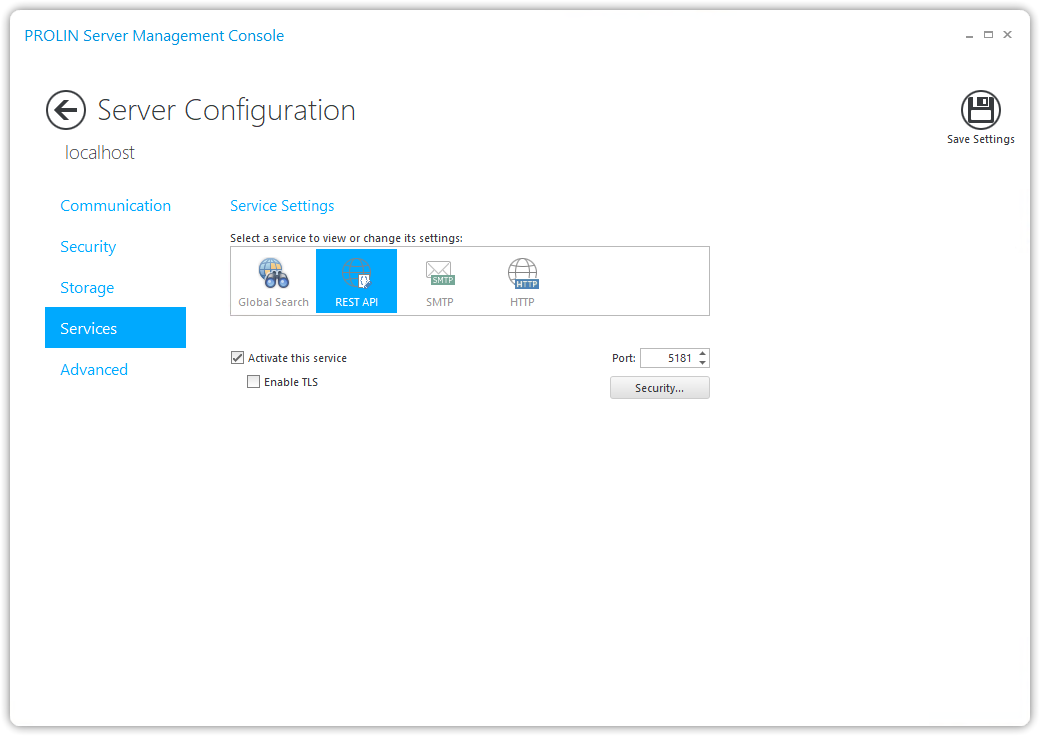
After saving settings and restarting the server, the REST API service will be available at:
http://<server>:5181/odataIf Enable TLS is selected, the endpoint will use HTTPS instead.
- You must bind the port to a digital certificate.
- The process depends on your organization’s security practices.
IP Address Filtering
Access to the REST API can be restricted using IP address filters.
Clicking the Security… button opens the REST API Security Settings dialog.
In this dialog, you can specify multiple IP address masks separated by a semicolon (;).
Supported Mask Types
| Mask Type | Example |
|---|---|
| CIDR range | 192.168.0.0/24 |
| Uni address | 127.0.0.1 |
| Wildcard | 127.0.. |
| Begin/end range | 169.158.0.0-169.158.0.255 |
| Bitmask range | 192.168.0.0/255.255.0.0 |
Denied IP addresses take precedence over Accepted IP addresses.
- If a remote IP address matches a Denied mask, it will be blocked.
- If both Accepted and Denied lists are empty, then all incoming requests are accepted.